Launched by the United Nations in 2021, the Decade of Ocean Science for Sustainable Development (2021–2030) – widely known as the Ocean Decade – represents an unprecedented global effort to transform how we generate, share, and apply knowledge about the ocean. Under the coordination of the UNESCO Intergovernmental Oceanographic Commission (IOC), the Decade provides a unifying framework for mobilising governments, researchers, the private sector, and citizens to deliver “the science we need for the ocean we want.”
This Decade is not simply a scientific initiative; it is a strategic response to planetary urgency. The ocean regulates our climate, sustains biodiversity, and provides livelihoods for billions of people. Yet, it faces accelerating pressures from pollution, overexploitation, and climate change. To reverse these trends, the Decade aims to ensure that ocean science delivers tangible, inclusive, and solutions-oriented outcomes, supporting the 2030 Agenda for Sustainable Development and its Sustainable Development Goal 14: Life Below Water.
UN Ocean Decade Actions: building a Global Network of Action
At the heart of the Ocean Decade lies a vibrant and evolving ecosystem of initiatives called the Decade Actions.
Each Action contributes to the collective mission by addressing one or more of the Ten Ocean Decade Challenges.
These challenges range from mapping the entire ocean floor, ending pollution, and protecting ecosystems, to ensuring equitable access to marine knowledge and technology.
By 2025, a considerable number of Actions had been formally endorsed by UNESCO/IOC, representing all ocean basins and regions of the world. Together, they constitute a living architecture of cooperation, linking global science programmes such as the Global Ocean Observing System (GOOS) and the Ocean Prediction Decade Collaborative Centre with regional initiatives, youth networks, and community-based projects.
Science Serving Society
The Ocean Decade Actions mark a decisive shift from fragmented research projects to coordinated, impact-driven science. Through co-design and multi-stakeholder participation, they align scientific priorities with societal needs, improving early-warning systems, enhancing climate models, supporting sustainable fisheries, and building coastal resilience. By integrating scientific knowledge into decision-making, the Decade Actions help governments and institutions to design evidence-based marine policies. They support the implementation of international commitments such as the UN Framework Convention on Climate Change, the Convention on Biological Diversity, and regional frameworks like the EU Mission “Restore our Ocean and Waters by 2030.”
An equally important feature of the Decade is its emphasis on open and equitable access to data. Actions promote interoperability, common standards, and FAIR data principles (Findable, Accessible, Interoperable, Reusable). In the international framework, either directly or indirectly, such efforts complement broader digital initiatives, including the European Open Science Cloud (EOSC) and the Digital Twin of the Ocean, ensuring that ocean data are shared across disciplines, borders, and generations.
Decade’s ultimate success will be judged not only by the number of projects launched but by the lasting change they produce. Its enduring legacy will be a world where science and society work together to restore and protect the ocean, ensuring that the momentum built between 2021 and 2030 continues to inspire cooperation well beyond the Decade itself.
Blue-Cloud project as UN Ocean Decade endorsed Action
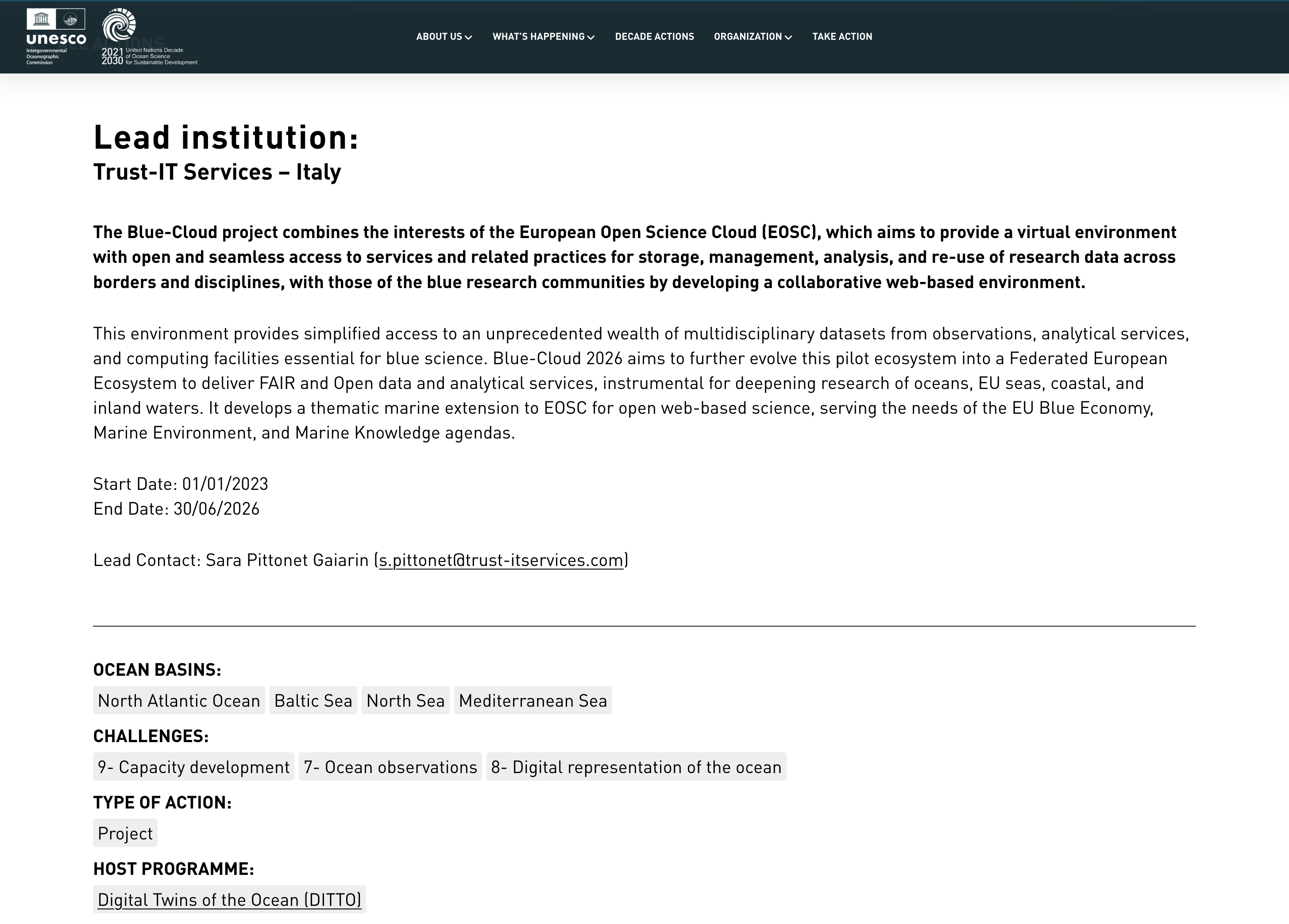
Since June 2024 the Blue-Cloud 2026 project has been endorsed by the IOC Executive Secretary as part of the UN Ocean Decade. It contributes particularly to Challenge 7 (Ocean Observations), Challenge 8 (Digital Representation of the Ocean) and Challenge 9 (Capacity development), strengthening the global capacity to collect, integrate, and use ocean data in an open and interoperable way.
Blue-Cloud supports the Digital Twins of the Ocean (DITTO) programme, which aims to develop dynamic digital models of the ocean to support evidence-based decision-making and the sustainable management of marine resources.
Visit the UN Ocean Decade Action page