
Eutrophication: chlorophyll, nutrients, oxygen
What the Workbench does
Eutrophication - the over-enrichment of coastal and marine waters with nutrients, often triggering harmful algal blooms and oxygen depletion - is one of the most pressing indicators of ocean health, directly relevant to policy frameworks like the EU's Marine Strategy Framework Directive (MSFD). But the data needed to track it comes from separate infrastructures, each applying its own quality-control conventions, meaning researchers previously had to reconcile these datasets by hand before they could even begin an analysis.
The Eutrophication Workbench removes that manual step. It automatically merges, harmonises and quality-controls in-situ data from three major infrastructures - Copernicus Marine Service, EMODnet Chemistry, and the World Ocean Database - targeting ocean colour (as a proxy for chlorophyll-a, indicating algal blooms and primary production), dissolved oxygen (to detect low-oxygen "dead zones"), and five key nutrients: nitrate, nitrite+nitrate, ammonium, phosphate and silicate, following GOOS (Global Ocean Observing System) recommendations. The workbench focuses specifically on preparing clean, trustworthy observational data rather than modelling or forecasting; it's the foundation other tools can build indicators on top of.
The engine: the Beacon data lake
The workbench is built around Beacon, an open-source data lake query engine that makes large collections of scientific data directly and quickly queryable. Each source infrastructure first gets its own dedicated ("monolithic") Beacon instance, which brings its data into a shared structure and vocabulary. These individual instances then feed into a single merged Beacon instance - the core of the workbench - where chlorophyll-a, nutrient and oxygen data from all three sources sit side by side in consistent units and formats.
From there, two purpose-built tools take over. The CW duplicate-detection tool scans the merged data for potential repeat observations based on their metadata, producing a list of likely duplicates. The FileForge tool, then, acts on that list, removing or annotating the identified duplicates and converting the result into different output formats, including ODV and parquet. Both tools run as containerised services on Blue-Cloud2026's Cloud Computing Platform, so the whole pipeline can be re-run consistently as new data becomes available.
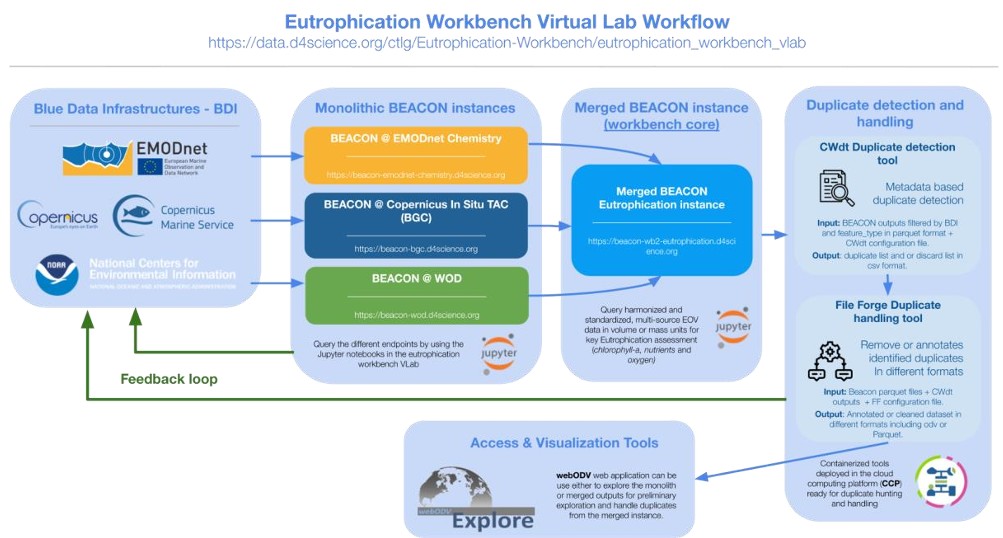
Conceptual architectural workflow and data progression within the Eutrophication Workbench
What it delivers
Originally piloted for the North East Atlantic, the resulting dataset now spans the global ocean, with records dating back to 1921 through to 2024. It's available in ODV and parquet formats and can be explored interactively through webODV, either as the merged dataset or broken down by source infrastructure. As an additional downstream product, gridded climatologies (computed using the DIVAnd interpolation method) are also available, ready to feed into eutrophication indicator calculations - for example through the Marine Environmental Indicator VLab.
Learn more about its workflows, tools and user documentation
This task if led by Alessandra Giorgetti, OGS. Watch Alessandra's Interview about this workbench
Contact the team to learn more